


Coffee Cup Lid Plug Sizes, Fit and Disposal Guide

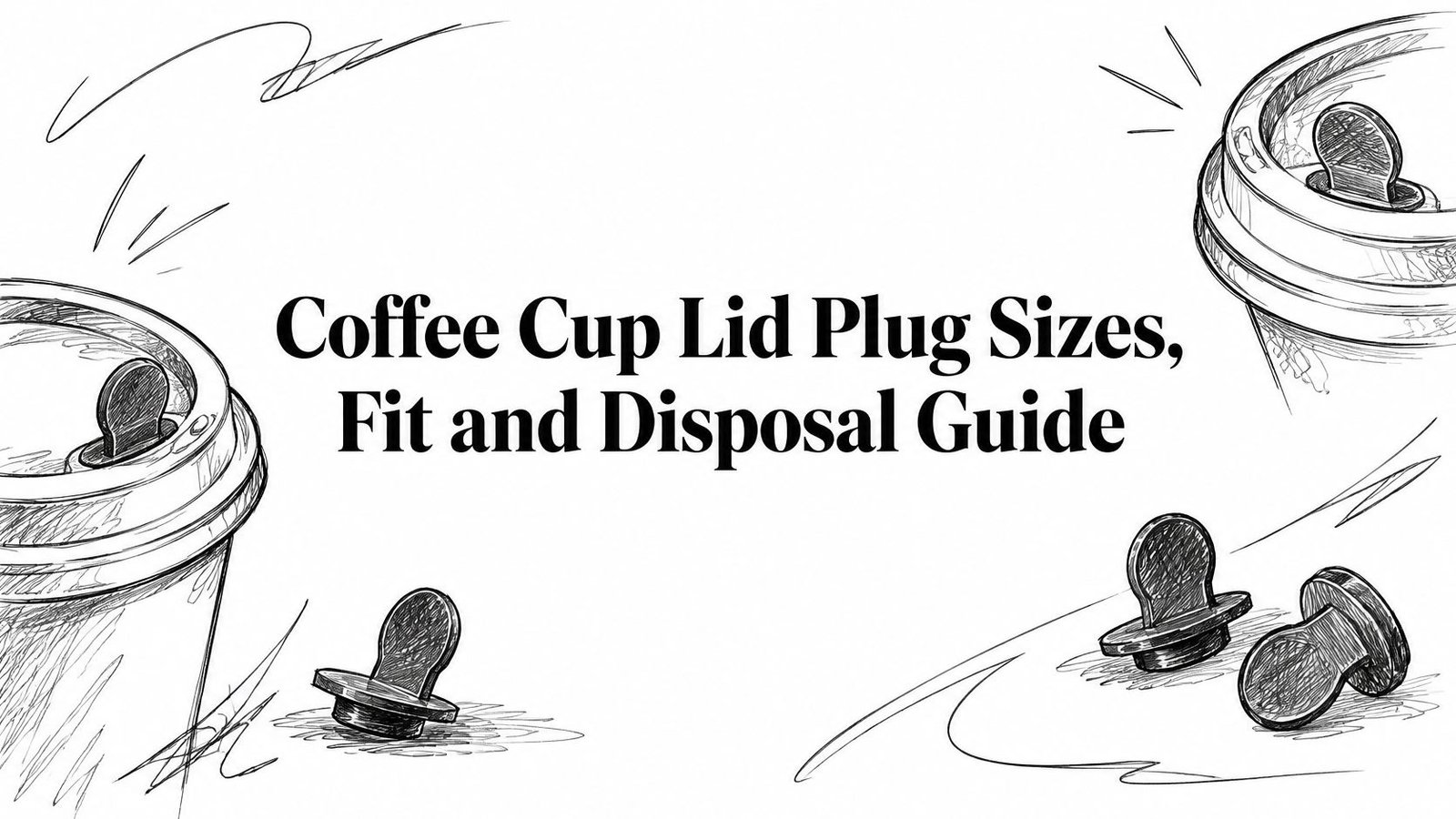
A flat white goes into a delivery bag looking sealed. Two minutes later it's soaked through the carrier, the sleeve is damp and the customer blames the café, not the tiny opening in the lid. That opening is where a coffee cup lid plug earns its keep, and also where it fails when it's matched to the wrong lid.
If you're buying cups in cartons, you can't treat plugs as a universal add-on. Treat the plug as its own part, with its own fit tolerance, material and disposal route, and most leaks and bin problems become preventable.
How a Coffee Cup Lid Plug Works and Stops Spills
Say a customer carries a latte out of your café, bag in one hand, phone in the other. She tips the cup slightly as she pushes the door. The lid stays on, but it flexes around the drinking aperture, hot milk surges against that open hole, and a splash lands on her coat sleeve. The cup didn't fail. The lid rim didn't fail. The unsealed hole did.

A coffee cup lid plug is the small insert or closure that sits in that aperture and controls how liquid leaves the cup. Think of it as a stopper in a sink. Without it, you've got an open hole that responds to every tilt and bump. With it seated properly, you've got a controlled opening that stays closed in transit and opens only for drinking.
The Three Parts That Do the Work
- Plug body: This fills the aperture itself. It's the visible cap the customer sees and touches, and its outer edge has to meet the lid surface without a gap.
- Flange or stem: This sits below or around the body and holds the plug in place. The stem grips the aperture edge, while a flange stops the plug pushing through into the drink.
- Lid aperture: This is the shaped hole moulded into the lid. Its length, width and edge profile decide which plug geometry will lock in and which will rock, leak or pop out.
When those three parts match, liquid leaves only when the drinker sips and draws it through. Pressure from carrying, a knock against a car door, or a brief inversion in a delivery bag is held at the plug rather than escaping at the lid edge. When they don't match, the plug becomes decoration. It looks closed from above while liquid tracks around an unsealed edge.
A Linked System, Not an Accessory
Don't judge the plug on its own. The cup rim, lid, aperture and plug work as linked parts, and each one depends on the others. A lid that isn't fully seated on the rim will flex differently, which changes how the aperture holds the plug. A rim that's slightly out of round can leave one side of the lid under tension, so the plug lifts on that side first.
That system view matters at UK scale. Parliamentary packaging evidence cited approximately 2.5 billion single-use coffee cups discarded in the UK each year, and noted that cups and lids are commonly disposed of together in public rubbish bins, so potentially recyclable components are often lost before they reach a suitable sorting system. A plug that stays attached, gets coated in drink residue, or can't be identified adds one more problem to that mixed disposal.
Volumes of lid material alone are not trivial. Scotland's government environmental assessment estimated 583.1 tonnes of lid material were placed on the Scottish market in 2021–22, alongside 4,566.6 tonnes of disposable beverage-cup material overall. Small fit decisions, repeated across that tonnage, shape both spill rates and waste quality.
Practical rule: Match the plug to the lid aperture first, then confirm the lid seals on the cup rim. Reversing that order hides the real cause of a leak.
Fit tolerance is where most failures start. A plug that's too loose increases leakage and burn-risk exposure, because hot liquid reaches skin or clothing before the customer expects a sip. A plug that's too tight can deform the lid around the aperture, crack a brittle edge, or make removal so awkward that the customer pulls the whole lid off and spills more than the plug saved.
Hygiene is the quieter benefit. A closed aperture keeps dust, fingers and stray drips off the drinking area during handling, stacking and storage on a busy counter. That matters most in delivery bags, car journeys, event service and workplace catering, where cups are carried by someone other than the drinker, set down repeatedly, and jostled in ways a counter handover never tests.
Be clear about the limit. Plugs aren't universal, and not every lid takes one. Some lids use a sip-through opening, some use a reclosable flap, and some dome lids have apertures shaped for straws rather than plugs. The useful questions are narrower. Does this plug fit this aperture? Does it stay seated with a hot drink? Can the customer remove it cleanly? And where does it go after use?
Sizes and Compatibility at a Glance
Start with the formats you stock, because the rim and aperture decide fit long before the plug brand does. Use our guide to coffee cup dimensions alongside your own sample measurements, then record the result for every cup and lid pairing you buy.
| Cup or lid | Common format | Rim or aperture to measure | Check before ordering |
|---|---|---|---|
| 4oz cup | Kraft ripple cup | Record the outer rim diameter in millimetres from your sample | Lid maker's fit range for 4oz |
| 7oz cup | Single wall paper cup | Record the outer rim diameter in millimetres from your sample | Lid maker's fit range for 7oz |
| 10oz cup | Single wall printed paper cup | Record the outer rim diameter in millimetres from your sample | Lid maker's fit range for 10oz |
| 12oz cup | Black or kraft ripple cup | Record the outer rim diameter in millimetres from your sample | Lid maker's fit range for 12oz |
| 16oz cup | Kraft or black ripple cup | Record the outer rim diameter in millimetres from your sample | Lid maker's fit range for 16oz |
| 12oz dome lid | Dome lid with drinking aperture | Measure the longest internal aperture length and width in millimetres | Plug retention force |
| 12/16oz PET dome lid | PET dome lid with drinking aperture | Measure the longest internal aperture length and width in millimetres | Plug retention force |
Three Checks in Order
First, measure the cup rim. Use callipers or a steel ruler across the outside of the rolled rim, then measure again at right angles. If the two readings differ noticeably, the cup is out of round and a lid may seal on one axis and gap on the other. Don't rely on the ounce size printed on the carton, because two 12oz cups from different ranges can carry different rims.
Second, check the lid aperture against the plug stem. Push the stem through by hand and look for even contact all round. A stem that touches at the ends but gaps along the sides will weep under pressure, even if it feels firm when dry.
Third, confirm the plug's stated fit range with the supplier before ordering in bulk. Ask for the aperture dimensions it's made for, not just a cup size. Get that range in writing, then keep it with your batch sheet so a future buyer doesn't reorder by product name alone.
The trap is assuming cup size equals lid system. The same 12oz cup can take a flat sip lid, a reclosable lid or a dome lid, and each presents a different aperture. A plug that locks into one may spin, sink or refuse to enter another.
Match the plug to the lid, then confirm the lid fits the cup rim. Ounce size alone tells you neither.
Test a sample cup and lid before you commit to a full pack. Fill it hot, carry it around the building, tilt it, and set it in the carrier you hand to customers. If it passes that, you've got a pairing worth ordering. If it doesn't, you've spent pennies learning it, not a carton's worth.
How to Fit a Plug to a Lid Step by Step
A consistent routine beats a strong thumb. Train the sequence below until it's the same on a quiet Tuesday and a Saturday rush, and use the range of lids for paper cups you stock as your reference set, not a borrowed sample from another range.

- Confirm the lid matches the cup rim before opening packs. Dry-fit one lid on one cup from the batches you'll serve that day. A mismatch here shows up later as a leak you'll wrongly blame on the plug, and opening every pack first leaves you with loose stock you can't return easily.
- Check the aperture is clean, dry and free of printing residue. Grit, dust from a store room, or a smear of residue stops the plug seating flat. The common slip is skipping this in a dusty store, then chasing a sealing fault that's really contamination.
- Align the plug stem with the aperture so the flange sits square. Look from above, not at an angle. Rolling the plug in from one end is the usual error, and it leaves the far end raised just enough to leak.
- Press evenly with the thumb until the plug sits flush, without forcing it. Spread pressure across the body rather than pushing one corner. Forcing a tight plug deforms the aperture edge, so even a correctly sized plug won't seal afterwards.
- Seat the lid onto the cup and press the rim all round. Work your fingers around the full circumference so the lid closes without gaps. Pressing only opposite sides leaves the other two sides proud, and the lid flexes there when carried.
- Test with a small amount of hot water, then tilt or invert gently and watch for seepage. Hot liquid softens some lids and changes the fit, so a cold test can pass a pairing that fails in service. Watch the aperture edge, not just the rim, and give it a few seconds under tilt.
- Record the result on the batch sheet so the same fit is repeated. Note cup size, lid type, plug type and batch codes. Without that record, a good result is luck, and the next order may change one part of the pairing.
What a Good Fit Looks Like
The plug sits flush with no raised corner you can catch a fingernail under. The lid seals on the rim without a gap, and it doesn't rock when you press the centre. Liquid flows only when the drinker sips, not when the cup is carried, tilted or set down firmly.
If staff need real force to achieve that, it isn't a good fit, it's a forced one. I'd stop and change the pairing rather than train people to push harder, because force hides a tolerance problem until heat and handling expose it in front of a customer.
Common Plug Problems and How to Fix Them
The complaint you'll hear most is simple. It leaked in the bag. Work backwards from the symptom before you blame the plug, because the same wet carrier can come from a loose plug, an unseated lid, a softened aperture or a rim that's out of tolerance.
| Symptom | Likely cause | Fix |
|---|---|---|
| Plug falls out when the cup is inverted | Loose fit in the lid aperture | Use a snugger plug and reseat it fully |
| Lid bulges or cracks when the plug is pushed in | Plug too large or too much force | Choose a smaller plug and press evenly |
| Drink leaks around the plug | Plug not seated, or lid softened by hot liquid | Reseat the plug, then retest with hot water |
| Plug is too hard to remove | Tight tolerance or deformed lid | Use a looser fit or a lid with a larger aperture |
| Plug slips during carrying | Weak plug retention | Replace with a plug that has higher retention force |
| Plug pops out once the drink is hot | Lid softened or plug not locked | Check lid material and retention force with the supplier |
Fixes a Shift Lead Can Make Today
Reseating a plug squarely, cleaning a dirty aperture, pressing the rim all round, and pulling a damaged lid from the stack are all same-day fixes. So is swapping to a snugger plug you already stock, provided you test it hot first. These cost nothing and they separate handling errors from specification errors quickly.
Removal problems sit in this group too, up to a point. If customers are wrestling plugs out, check whether staff are forcing them in at an angle and deforming the aperture. Retrain the press, retest, and only then conclude the tolerance is wrong.
Changes That Need the Supplier
A plug that pops out when hot, slips under normal carrying, or cracks lids on insertion is telling you the specification is wrong. You need a different plug size, higher retention force, a larger aperture, or a lid material that holds its shape with hot liquid. Ask the supplier to confirm the fit range and retention against your measured aperture, in writing.
On repeat leaks: If a leak continues across batches, check cup rim tolerance and lid material rather than the plug alone. A perfect plug can't seal a flexing lid.
Log each failure with the cup size, lid batch and plug type, plus whether the drink was hot and how it was carried. Patterns appear fast. Three failures on one lid batch is a supplier conversation. Three failures across every batch on delivery orders only is a handling and retention conversation. Without the log, both look like bad luck, and you'll keep reordering the same problem.
What Happens to the Plug After Use
Start with the uncomfortable reality, because it should shape what you print on your bins. A Scottish Government knowledge account reported that only about 1 in 400 disposable coffee cups, 0.25%, were believed to be recycled in the UK, because conventional cups combine paper with an internal plastic lining and require specialist collection and reprocessing. The account also sets out that UK coffee-cup waste is not widely accepted through ordinary local-authority recycling systems.
| Component | Typical material | Disposal action |
|---|---|---|
| Paper cup | Paperboard with plastic lining | Specialist collection where available; usually not kerbside recycling |
| Lid | Commonly hard polystyrene | Remove and sort where local rules require |
| Plug | Polymer to confirm with supplier before ordering | Follow the route for the confirmed polymer and local council rules |
Why the Plug Is the Unknown
You can usually identify the cup and make a fair assumption about the lid. The plug is different. Its polymer may differ from the lid it sits in, it may carry no marking a customer can read, and it's small enough to be lost in sorting even when it's separated correctly. A technically recyclable component can therefore have little practical recovery value if it's contaminated, unidentified, or separated from an appropriate collection stream.
Lids also escape bins entirely. The Marine Conservation Society Beachwatch 2025 report found plastic caps and lids present on 83% of UK and Channel Island beaches surveyed in 2025. A clear disposal line at the counter won't solve littering, but a vague one guarantees your customers guess.
Our overview of whether coffee cup lids are recyclable covers lid routes in more depth, and operators who report packaging outcomes formally may also need support for UK corporate sustainability reporting so that what's claimed publicly matches what their collection contracts achieve.
The Decision Rule
- Polymer confirmed and your council accepts it: Separate the plug, and tell customers to separate it, in one short line at the bin.
- Polymer unconfirmed or not accepted locally: Keep it with general waste and say so on the bin label. Don't invite people to put it in recycling on hope.
Keep the distinction sharp. Recyclable in a controlled specialist facility is not the same as accepted in a normal kerbside system, and confusing the two increases contamination and undermines the claim on your menu board. Contaminated recycling loads can be rejected, which leaves you worse off than an honest general waste instruction.
Two actions close the gap. Confirm the plug polymer with your supplier, in writing, for every plug and lid pairing you stock. Then write one clear line of customer disposal instructions based on your actual collection scheme, not the packaging artwork. If you can't write that line yet, you don't know your disposal route, and that's the thing to fix first.
Source the Right Plugs for Your Business
Buy plugs the way you'd buy a lid pairing, with questions the supplier has to answer for each product, not a catalogue description. Public pressure makes this more than a leak decision. A 2021 UK poll reported by PR Newswire reported that 73% of respondents supported an immediate ban on single-use plastic lids, while 87% considered such lids a significant source of environmental pollution and litter. Customers read your lid choice as a statement, whether you intended one or not.

Five Questions for Every Supplier
- Rim diameter suited: Which cup rim diameter is this plug and lid pairing made for, in millimetres?
- Lid material and aperture size: What's the lid made from, and what aperture dimensions does the plug fit?
- Plug polymer: What exactly is the plug made from, and is it marked or documented?
- Retention force: How firmly does the plug hold, and how was that measured?
- Hot test results: What happened after hot filling, carrying and inversion, using which cup and lid batch?
Ask for the lid maker's fit range in writing, not just a product name. Names get reused across ranges, and a name match has caused more wrong orders than any measurement ever has. Compare two or three suppliers on the same five questions so the answers are comparable, then order a sample set before committing to a full carton. Record the cup and lid batch in every test so a failure can be traced to a pairing, not guessed at.
For context on the lids these plugs must suit, we stock 12oz sip-tru white lids in packs of 50 pieces or 50 pieces x 20 packets at £1.89 to £18.99, 12oz reclosable white lids in packs of 50 pieces or 50 pieces x 20 packets at £1.99 to £19.99, and 12/16oz PET dome lids in packs of 50 pcs or 50pcs x 20PKTS at £1.99 to £24.99. Check the product page or ask the team whether a plug is listed for your chosen lid rather than assuming one is, because a reclosable or sip-tru design may do the plug's job without a separate part.
Don't buy on a recyclability claim alone. Ask for the polymer of both plug and lid, and the disposal route each one needs.
Workplace buyers have one extra variable. If your cups serve a staff kitchen as well as customers, the drinks may be filled hotter and carried further, so test at the temperature your machine dispenses. Facilities teams sourcing boiling water for workplace coffee breaks should run the same hot tilt test on their office pairing, since a lid that holds at café serving temperature can soften at near-boiling fill.
Your next step is small and specific. Measure one cup rim, check the lid aperture against the plug stem, and order a test sample before committing to bulk. I'd rather you tested ten cups thoroughly than discovered a tolerance problem across ten thousand.
Measure your rim, test one hot pairing, and then order with confidence from Monopack ltd, where you'll find the cups, lids and food-to-go packaging to build a plug and lid combination that seals. Browse the range, compare pack sizes for your volume, and ask the team to confirm fit for your chosen lid before you commit to a carton.


