


Best Practice Guidelines for UK Food Businesses

The coffee queue is growing, a delivery has arrived, and someone's asking where the latest cleaning record is kept. Then a food hygiene inspector walks through the door. Your team knows how to run the café, but can they show that the important checks happen consistently, even when you're not there?
Best practice guidelines help close that gap between knowing what good work looks like and making it repeatable. For small UK food businesses, the most useful guidelines connect customer safety, packaging choices and everyday decisions to clear responsibilities and records.
Why Best Practice Guidelines Matter for Your Business
Consider a hypothetical café where the counter looks spotless, but the manager can't find the supplier paperwork for a replacement takeaway cup. The closing checklist is unsigned, and different staff members describe different cleaning routines. Nobody intended to cut corners, but the business has no reliable way to demonstrate what happened.
The problem isn't a lack of effort. It's a lack of shared, checkable procedures. A useful guideline tells the person receiving that cup delivery what to check, where to record approval and what to do if information is missing.

Make good work demonstrable
Across England, Wales and Northern Ireland, establishments found broadly compliant with food-hygiene law or better increased from 89.0% in the financial year ending 2015 to 90.4% in the financial year ending 2020, according to the United Kingdom Food Security Report's food safety findings. These figures describe improvement, although they don't establish that written guidelines alone caused it.
For an operator, the practical lesson is to make standards observable. You should be able to identify who completed a task, whether the result was acceptable and how any problem was resolved.
- Protect customers: Give staff an agreed response when a safety check fails, rather than leaving them to improvise.
- Protect service: Make essential information accessible when the manager is busy or absent.
- Protect purchasing decisions: Stop unapproved substitutions from becoming routine because they arrived with a delivery.
For owners coordinating several locations, Franchise Foundry's franchise system improvement tips offer a wider operational resource to consider alongside food-specific requirements. The useful question is whether each location can follow the same essential controls without depending on the same person.
Practical rule: If only the owner knows how a critical task should be done, the business hasn't yet made that task repeatable.
The aim isn't a heavier folder. It's a calmer shift, clearer decisions and evidence that your team follows the standards you've set.
Understanding Best Practice Guidelines and Their Purpose
Think of a recipe that another cook can follow successfully. It identifies the ingredients, method and expected result, rather than assuming everyone shares the original chef's judgement. Best practice guidelines serve a similar purpose for the work surrounding food preparation and service.
They describe an agreed way to perform a task consistently. A useful guideline also explains its boundaries: when it applies, who's responsible and when someone should stop and ask for help.

Separate requirements from your chosen method
Legal requirements and best practice aren't interchangeable. Your internal document should distinguish an obligation from the method you've chosen to fulfil it, and from an additional quality check.
For example, a packaging approval procedure might combine applicable food-contact requirements with your own checks for lid fit and ease of handling. Those checks belong together operationally, but they don't all have the same legal status. Resources on food safety compliance can help frame the broader discussion, while your own procedures should reflect your actual operation.
- Requirement: Identify the applicable obligation and retain its authoritative reference.
- Method: Describe how your team will meet it in this workplace.
- Evidence: Specify the record or observation that demonstrates completion.
Visible performance can support this approach. The Food Standards Agency's hygiene-rating display audit found that approximately 67% of food businesses in England displayed their rating in 2022, compared with 55% displaying a sticker in 2017.
The same audit found that 99% of English, 97% of Northern Irish and 98% of Welsh food businesses agreed that they worked hard to maintain or improve their rating. These findings show the relevance of visible standards, without proving that display alone changes behaviour.
For your business, customer trust and internal accountability should reinforce each other. Do not write procedures purely to look organised during an inspection. Write them so that the evidence reflects what staff do.
Core Components of Effective Guidelines
A cleaning instruction that says “keep the preparation area hygienic” leaves too much unanswered. Staff still need to know the method, approved products, timing, responsibility and response to a missed task.
Build your guideline system around clear standards, documented procedures, staff training, monitoring and corrective action. Each component answers a different operational question.

Define the result and the method
Start by describing an acceptable outcome. For packaging purchasing, that could mean staff can confirm that an approved item is suitable for its intended food and conditions before use.
The Food Standards Agency's food-contact materials guidance includes transport containers, packaging, kitchenware and tableware, and explains that regulated materials placed on the Great Britain market must be authorised where applicable. It also identifies general safety and Good Manufacturing Practice requirements.
Turn that into a purchasing control: request relevant compliance documentation, material specifications, intended food types, temperature limits, contact duration and migration-test evidence where relevant. Keep the evidence against the product reference so staff can connect the approval to the item delivered.
Give people the means to follow it
- Document the procedure: Put instructions where the task happens. A receiving checklist belongs beside delivery records, not solely in an office manual.
- Train through demonstration: Ask staff to perform the task and explain what would make them reject or escalate a result.
- Monitor actual work: Compare completed records with what you observe during service.
- Close the problem: Record the immediate correction, the underlying cause and who will confirm that the change works.
For preparation controls, a practical resource on preventing cross-contamination can support discussions about how tasks should be separated and communicated. For wider operational context, 10Seat's guide for restaurant operators is another resource to review alongside authoritative requirements.
Keep essential outcomes clear while allowing sensible local arrangements. Different kitchens may store records differently, but staff should never have to guess whether a product or process has been approved.
How to Create Your Own Best Practice Guidelines
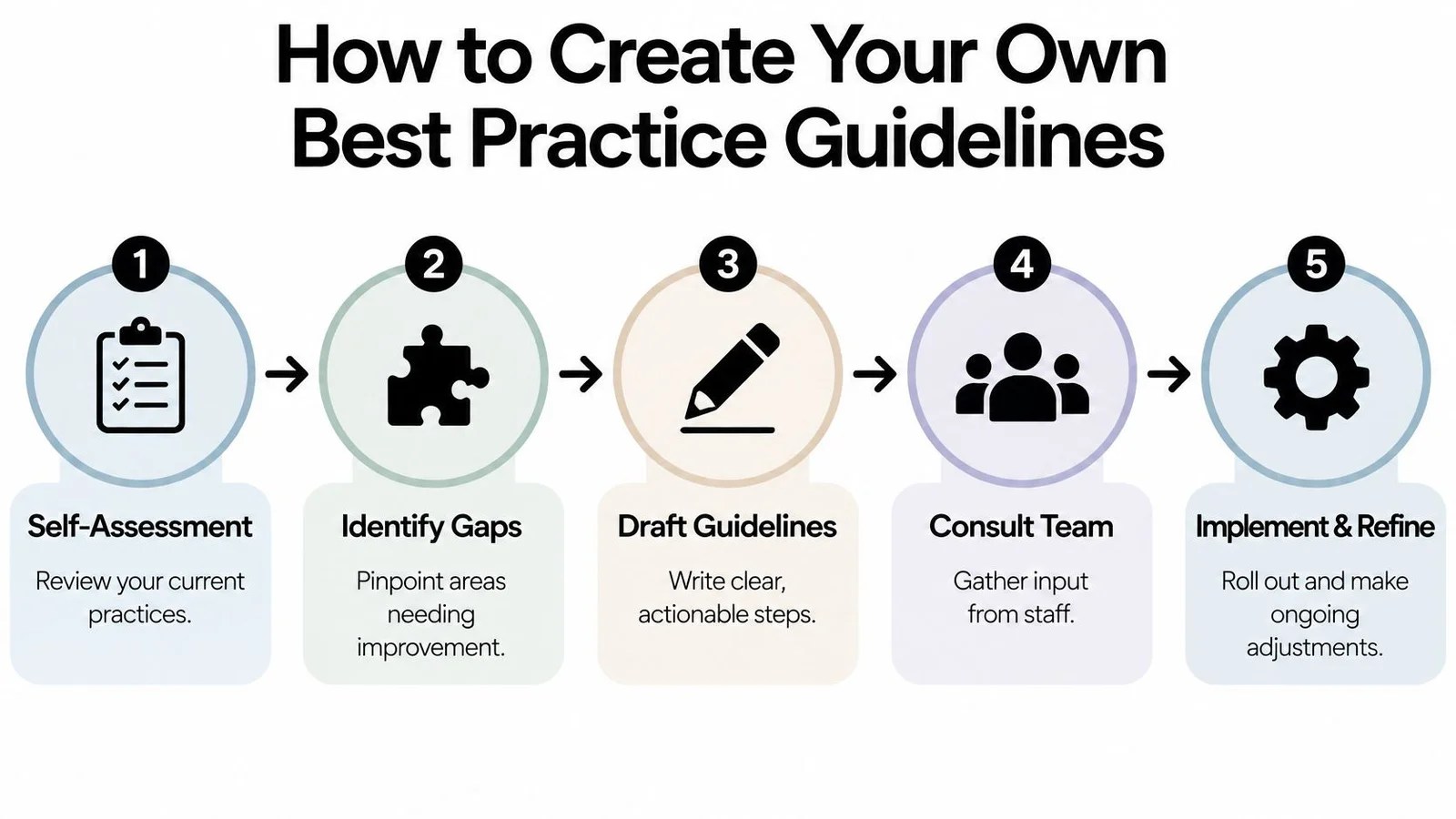
Begin with a normal working shift, not a blank policy template. Follow a delivery through receiving, storage, preparation, service and disposal, and note where staff hesitate, improvise or ask the owner for an answer.
Ask the people doing the work to explain the awkward parts. A delivery driver's arrival time, an inaccessible cupboard or a crowded service station may reveal why an otherwise sensible instruction isn't followed.
Turn observations into usable instructions
Compare current practice with applicable requirements, supplier instructions and your own service expectations. Separate safety-critical gaps from inconveniences, then address the issues with the most serious consequences first.
Draft instructions using an action, an owner and a response. Instead of asking staff to check packaging, tell the receiving colleague to compare the delivered product reference against the approved list and hold unrecognised substitutions for manager review.
- Choose the right format: Use a checklist for repeated checks, photographs for storage arrangements and a decision tree for uncertain situations.
- Name the decision-maker: Identify who can approve an exception and who provides cover when they're absent.
- Make escalation practical: Explain where held goods go and how colleagues will know not to use them.
A procedure shouldn't depend on staff remembering an explanation they heard during induction. Include enough information to act safely, but keep background material separate from the task instructions.
Test before you formalise
Give the draft to someone who didn't write it. Ask them to follow it during realistic working conditions, including interruptions and handovers, while you observe without filling in the gaps.
A procedure isn't finished when the writer understands it. It's ready when another person can use it without guessing.
Revise anything that causes confusion, then assign a document owner and review date. Remove obsolete copies so staff aren't choosing between conflicting versions.
Avoid trying to document every activity at once. Finish a workable procedure for a priority task, test it, and use what you learn to improve the next document.
Implementing and Maintaining Guidelines Over Time
A new procedure can look straightforward during a quiet briefing and fail during the lunch rush. Introducing it properly means showing staff how it works at the station, with the supplies and equipment they will use.
Ask each colleague to demonstrate the task, including what happens when something goes wrong. For a replacement takeaway container, that means knowing the approved alternative, not just remembering which container is normally used.
Build checks into existing responsibilities
Attach oversight to work that already happens. The person opening the café can check that current instructions are available; the shift lead can review unresolved issues during handover.
| Working moment | Suggested management check |
|---|---|
| Staff induction | Observe the task and record any support needed |
| Shift handover | Confirm outstanding problems and their owners |
| Supplier or menu change | Check which instructions need revision |
| Management review | Examine recurring failures and overdue actions |
Use targeted observation, not just completed paperwork. A signed checklist tells you someone recorded a task; watching the task helps you assess whether they understood the method.
Customer feedback can also identify questions worth investigating. A report of a leaking container should prompt a review of the product, filling method and handling conditions rather than an automatic assumption that staff used it incorrectly.
Correct the cause, not just the record
When someone misses a check, establish what happened. Was the instruction unclear, the necessary equipment unavailable, or responsibility lost between shifts?
- Make the situation safe: Follow the relevant procedure for the immediate problem.
- Investigate without assumptions: Speak to the people involved and inspect the working conditions.
- Verify the change: Observe a later shift to confirm that the revised arrangement is practical.
The rating-display findings discussed earlier provide a useful reminder that performance should be visible. Internally, show staff the status of actions they can influence, rather than posting results without explanation.
Refresh training when tasks change or observations reveal uncertainty. Maintenance is successful when managers can see not only that a problem was recorded, but that someone checked whether it stayed resolved.
Sector-Specific Examples for Cafés, Takeaways and Caterers
A café serving drinks across a counter, a takeaway sending meals off-site and a caterer operating at an event face different handling conditions. Their best practice guidelines should reflect those differences rather than copying the same checklist.
The shared principle is control at the point where a decision affects the product. The useful detail is who makes that decision and what information they need.
Sector-Specific Best Practice Priorities
| Sector | Key Focus Area | Example Practice |
|---|---|---|
| Cafés and bakeries | Hot-drink packaging and service-station organisation | Match approved cups and lids, and keep alternatives clearly identified |
| Takeaways and street-food vendors | Container suitability and delivery handling | Trial the proposed pack with the actual menu item and delivery arrangement |
| Caterers and event teams | Transport, venue setup and handovers | Allocate responsibility for dispatch, arrival and service checks |
Match the control to the service
For cafés, consider how staff select cups during a busy shift. Keep incompatible lids apart, label approved combinations and prevent loose stock from becoming an unidentified mixture. A practical trial can assess lid fit and handling, but it doesn't replace the food-contact evidence established during purchasing approval.
Customer-facing bins need equally specific instructions. Test whether customers can see the labels while holding a drink and whether staff can empty each stream without mixing the contents.
For takeaways, evaluate packaging with the food you sell. A container that appears suitable when empty may be awkward to fill, stack or carry once it contains a sauced meal. Record observations about closure, leakage and handling, then agree which menu items can use that pack.
Don't confuse a successful handling trial with proof that temperature controls are adequate. Keep packaging selection and food-temperature checks connected but separately documented.
For caterers, plan the handovers. Identify who checks transport containers before dispatch, who accepts them at the venue and who records relevant conditions during service.
- Before departure: Confirm that supplies match the event plan and approved product list.
- At the venue: Check the actual layout against the planned working arrangements.
- During pack-down: Assign responsibility for unused supplies, waste and unresolved issues.
A procedure that works in your own kitchen may need adjustment at a temporary venue. Confirm the local arrangements before service begins, rather than relying on staff to negotiate responsibilities while guests are waiting.
Templates, Checklists and Measurement Methods
Use a short document that answers the questions staff ask. Keep technical evidence in a supporting file, with a clear reference from the working instruction.
The following template is a starting point, not a substitute for assessing your own operation.
A working guideline template
| Field | What to record |
|---|---|
| Purpose and scope | The task covered and where the instruction applies |
| Owner and cover | Responsible role and authorised deputy |
| Method | Actions, equipment and relevant supporting documents |
| Acceptance criteria | What an acceptable result looks like |
| Exception response | What to stop, hold, report or escalate |
| Evidence and review | Record location, document version and review trigger |
Opening and closing prompts
- At opening: Confirm that required supplies are available, approved packaging is identifiable and outstanding issues have been handed over.
- Before service: Check bin labels, workstation instructions and the allocation of cleaning responsibilities.
- At closing: Complete scheduled cleaning records, identify held stock and pass unresolved actions to the next responsible person.
Measure performance and follow-through, not the volume of paperwork. Useful measures include observed tasks completed correctly, training awaiting demonstration, repeat packaging complaints and corrective actions still open.
For each measure, define what counts, who records it and what triggers management attention. If colleagues classify the same event differently, the resulting figures won't support a reliable comparison.
Build a packaging evidence register
GOV.UK's packaging producer-responsibility guidance says organisations supplying or importing packaging may need to register on the packaging data service, submit data and pay environmental-regulator fees. Don't assume those obligations apply identically to every café; assess your organisation's role against the guidance.
For each active stock-keeping unit, record material type, component, weight, recycled content where evidenced, packaging category, destination market and supplier-document reference. Mark missing information explicitly rather than treating an empty cell as confirmation.
Measurement check: A record is complete only when someone else can trace its information back to evidence.
Choose completeness as an internal management goal, then investigate the gaps. This gives purchasing staff a practical list of questions to resolve before the next order or product review.
Eco-Friendly Packaging Guidelines for Modern Food Businesses
Choose the packaging system, not just the material label. A bagasse clamshell, compostable bowl or recycled-content cup still needs to suit the food, service conditions and available disposal route.
Use the approval controls described earlier before considering environmental positioning. A biodegradable description isn't permission to use an item for any food or temperature, and it doesn't tell customers which local collection will accept it.
Check what happens after service
England's Simpler Recycling rules took effect on 31 March 2025, requiring workplaces, including cafés, restaurants, pubs and takeaways, to separate dry recyclables and food waste before collection; micro-firms have an extended deadline until 31 March 2027, according to GOV.UK's workplace recycling guidance.
Translate the applicable requirements into arrangements your site can operate. Confirm accepted materials with your collector and test the proposed storage and collection routine before committing to new packaging.
- Label actual items: Use recognisable examples from your menu rather than broad environmental slogans.
- Address residues: Explain what customers and staff should do with leftover food and drink.
- Resolve rejected items: Name who contacts the collector when an item's destination is unclear.
Treat reuse as an operating model
UK research examining reuse trials links inconvenience with limited availability of participating retail locations and notes that several trial systems stopped operating. A reusable container therefore needs a workable return network, not just willing customers.
Compare return behaviour, transport, washing energy and water, breakage and hygiene arrangements. Reusables may fit a controlled dine-in or event setting, while dispersed takeaway demand needs a separate assessment; neither format is automatically environmentally preferable.
Use this explanation of sustainable packaging to frame questions for suppliers. Ask for evidence that supports the specific claim you intend to make, and avoid implying that a material name proves the whole system works.
Monopack ltd offers catering disposables, food-to-go packaging and hygiene supplies for cafés, takeaways and caterers. Visit Monopack ltd to explore suitable formats, then use your approval checklist to ask about intended food use, supporting documentation and disposal requirements before ordering.


