


Plastic Corner Protector: A Practical UK Buying Guide

A pallet leaves the warehouse looking secure. The stretch film is tight, the straps are tensioned, and the cartons appear square. Then a sharp edge cuts into the film, a strap crushes the outer board, or a fork-truck impact knocks one corner out of line. By the time the load reaches the customer, a small packaging weakness has become damaged goods, rework, or a rejected delivery.
A plastic corner protector is a small component, but it changes how pressure travels through a packed load. The right profile spreads strap and film pressure, protects exposed carton edges, and helps a stack remain stable during handling. The wrong profile is just another loose item on the pallet.
UK buyers should make the decision around load geometry, material behaviour, reuse, moisture exposure, and end-of-life handling, not around a product photograph or the lowest unit price. The following guide gives you the practical buying view.
What a Plastic Corner Protector Actually Does
A catering pallet is a useful example. Trays of packed meals are stacked, wrapped and sent towards a regional depot. As the stretch film tightens, every exposed carton corner becomes a pressure point. Without protection, that corner can cut the film, allow the strap to bite into the board, and weaken the stack before the next forklift movement.
A plastic corner protector fits over the vertical edge of a carton, palletised load, bundle or finished product. It sits between the outer packaging and the stretch film, or directly against the load before strapping. Its job isn't to secure an unstable pallet by itself. It gives the securing system a broader, more reliable surface to work against.

The three jobs that matter
A corner protector performs three practical functions:
- It protects the load. The protector takes the direct contact from strapping and reduces crushing, strap marks and film cutting into the carton edge.
- It protects the packaging system. Sharp or hard corners can cut stretch film and damage straps. The protector creates a smoother contact point.
- It supports stack geometry. By spreading pressure along the corner, it helps keep cartons aligned instead of allowing the strap to pull one edge inward.
UK distributors commonly specify these products by leg length or depth and offer open, closed, HD closed, edge, L-edge and U-edge versions. Examples listed by UK suppliers include 28 x 50 mm, 35 x 60 mm, 40 x 60 mm and 35 x 1000 mm profiles, as shown in UK distributor specifications for strapping edge protectors.
Practical rule: use the protector to distribute force, not to compensate for poor stacking, inadequate stretch film or incorrect strap tension.
That distinction matters in every operation. If cartons lean, voids remain unfilled or the pallet base is weak, a protector won't correct the underlying problem. For wider logistics context, buyers managing international movements can also review guidance on automotive export logistics from Canada, particularly where loads face repeated handling across different transport stages.
Main Types and Shapes Explained
Product quotes often use shape names that sound interchangeable. They aren't. The profile determines which faces of the load receive support and how the protector behaves when a strap, film layer or adjacent pallet applies pressure.
An open L-profile covers the outside of a single corner. It's the everyday choice for cartons and pallet loads where the main risk comes from vertical straps or film tightening across two exposed faces. It uses less material than a closed channel and is easy to place quickly on a despatch line.
A closed U-channel wraps further around the edge. It suits bundles, doors, worktops and other products where both sides of the edge need a more secure sleeve. The deeper coverage also helps where the component may be lifted, moved or stored for longer periods before dispatch.
Match the shape to the failure
An edge-board style protector behaves like a plastic angle board. It gives a broad contact face where strapping crosses a wider carton or pallet side. This is useful when a narrow protector would allow the strap to ride over the edge and concentrate pressure in one location.
Expandable or wrap-around versions are useful for mixed carton thicknesses. UK supplier data includes expandable ranges such as 18–40 mm and 14–40 mm, which can accommodate changing board calipers within the same dispatch operation. That makes them practical for mixed-SKU warehouses where a fixed channel would either slide or require several stock lines.
Taller pallet-stack or column protectors run along more of the load height. They're intended for vertical support across a column or a tall stacked unit rather than a short, isolated carton corner.
For delicate products, a buyer may also compare rigid protection with softer packaging such as foam corners boxed new. Foam can be appropriate where impact cushioning and surface softness matter more than strap distribution, while a shaped plastic profile is usually the stronger choice for strapped pallet stability.
| Shape | Edge Coverage | Best For |
|---|---|---|
| Open L-profile | Two outside faces of one corner | General cartons, catering loads and routine strapping |
| Closed U-channel | Wraps around the edge and covers both sides more deeply | Bundles, doors, worktops and longer-term stability |
| Edge or angle-board style | Broad face across the strap contact area | Wide straps and loads vulnerable to top-edge crushing |
| Expandable or wrap-around | Adjustable coverage across variable widths | Mixed carton thicknesses and changing board calipers |
| Tall column protector | Extended vertical coverage | High or stacked pallet loads needing column support |
Choose the shape from the failure you're trying to stop. A product code matters less than whether the strap cuts in, the film tears, or the stack loses its square profile.
Materials, Stiffness and Recycled Options
A strap can hold a pallet square or crush its carton corners. Material choice decides which outcome you get, especially when loads sit in storage or travel through repeated handling. UK suppliers commonly offer polypropylene, LDPE or recycled-content versions, but these materials are not interchangeable.
Polypropylene, or PP, is the rigid default. It keeps its shape under strap pressure and spreads force across a wider area. Choose it for uniform pallet loads, heavier cartons and applications where the protector must remain dimensionally stable during storage and transit. PP is usually the better choice than board when moisture, repeated handling or consistent strap tension would weaken fibre-based protection.
LDPE is softer and more compliant. It follows irregular edges and reduces the risk of marking the outer face. Select it when surface care and a forgiving fit matter more than maximum stiffness. It also suits loads whose product edges vary slightly between batches.
Recycled content changes the buying question
UK product specifications identify injection-moulded polypropylene and LDPE/PP materials. Some suppliers offer 100% recycled polypropylene and 100% recyclability, while others list recycled or recyclable formats, as described in Essentra's UK corner protector material specifications.
Treat a broad “eco” label as a starting point, not proof. Ask whether the stated recycled content applies to the exact profile supplied, whether it is recycled PP or LDPE, and whether the supplier can provide supporting documentation. Recycled grades may show more colour variation than virgin material. That seldom affects protection, but it can matter for visual standards or stock identification.
Testing matters when the load faces real distribution stress. Packaging-testing providers identify ISTA, ISO, ASTM and EN standards for validating protection systems. Request test evidence when the protector must perform consistently through storage, transport and handling, rather than judging stiffness by appearance alone.
| Material | Stiffness & Feel | Typical UK Use | End-of-Life |
|---|---|---|---|
| Virgin PP | Firm, rigid and shape-stable | Strapped pallets and load-spreading applications | Check local collection route and supplier guidance |
| LDPE | Softer, flexible and forgiving | Irregular edges or surfaces needing gentler contact | Collection depends on local and trade recycling arrangements |
| Recycled PP | Firm with possible colour variation | Reusable or lower-impact pallet protection | Recyclability claim needs confirmation for the specific product |
| Recycled-content blend | Performance depends on formulation | Mixed packaging operations seeking recycled content | Ask for material and recycling documentation |
My recommendation is direct. Start with PP for rigid pallet loads. Use LDPE where compliance and surface care take priority. Choose recycled content only when the supplier documents the composition and an achievable UK end-of-life route. Recycled plastic can compete with biodegradable alternatives on practical protection, but its environmental case depends on what happens after use, not the label alone.
How to Choose the Right Size and Profile
A poorly sized protector either fails at the carton edge or shifts under tension. Too small, and pressure concentrates on the board. Too large, and the profile can slide, allowing the strap or film to touch the load directly. Specify the fit from the actual pallet, not from a generic product description.
Start with the leg length or depth. Measure the exposed corner and cover the complete contact zone created by the strap and film. UK distributor ranges include 28 x 50 mm, 35 x 60 mm, 40 x 60 mm and 35 x 1000 mm profiles in different forms, as shown in UKPLC's sizing information for strapping edge protectors.
A practical measuring sequence
- Measure the carton or load edge. Record the board thickness and the width of both exposed faces.
- Check the strap position. Extend the protector beyond the strap's contact area. Do not finish it exactly at the strap edge.
- Match the channel width. The channel should grip the corner without forcing the board inward or leaving space for movement.
- Allow for variation. Mixed SKUs and inconsistent board calipers may require an expandable profile instead of a fixed channel.
- Trial the fitted load. Apply the planned strap and film combination, then confirm that the protector remains flush.
Board construction affects the choice. Thicker corrugated cartons need a deeper channel than lighter board. Mixed pallets may contain several edge dimensions, so a forgiving profile can reduce fitting failures. Wide polyester straps also need a broad contact face to prevent them riding over the protector.
| Load Type | Leg Length (mm) | Channel Width (mm) | Best For |
|---|---|---|---|
| Light uniform cartons | Confirm against the carton edge | Match the actual edge | Routine despatch with consistent packaging |
| Mixed carton load | Cover the tallest exposed contact zone | Accommodate the expected variation | Multi-SKU pallets |
| Heavy strapped cartons | Cover the full strap height and adjacent faces | Use a deeper, firm-fitting channel | High-pressure strapping |
| Tall pallet column | Provide extended vertical coverage | Match the column edge | Stacked or high-profile loads |
For warehouses handling many SKUs, standardising on two tested sizes is usually more practical than specifying a separate profile for every carton. Keep the fit tight enough to stop movement, and reject any protector that must be forced onto the corner. That simple trial prevents a catalogue size from becoming a recurring pallet failure.
Installation, Strapping and Stacking Best Practice
Consider a catering-to-go operation sending wrapped meal trays from a central kitchen to regional depots. The pallets are stacked, film-wrapped and cross-strapped. The correct sequence starts before the strap touches the load.
Place a protector on every exposed vertical corner, seating the channel flush against the carton edge. If there's a visible gap, the protector can shift when tension is applied. If the profile is sitting at an angle, the strap may pull it sideways instead of pressing evenly across its face.
The correct order on the pallet
- Position first. Fit the protectors to the corners while the load is still accessible.
- Strap to the specified setting. Use the strap manufacturer's recommended tension. Maximum tension isn't automatically better because excessive force can crush the protector into the board.
- Wrap over the protectors. Let stretch film pass over the tops so it helps hold them in position.
- Inspect before movement. Check that each protector remains aligned before the pallet is lifted.
A loose strap allows lateral movement, while an over-tight strap creates local crushing. The protector only works when the load, strap and film operate as one system.
For double-stacked pallets, extend protection across the full height of the lower unit, then fit shorter pieces to the upper tier where needed. After cutting straps, inspect the corners again before forklift pickup. A protector that slipped during unloading or strap removal won't protect the load during the next handling step.
Use the pallet stacking guidance alongside practical load safety for transport managers. These checks reinforce the point that edge protection supports load security, but doesn't replace a stable stack or suitable restraint.
Plastic Versus Board and Other Eco Alternatives
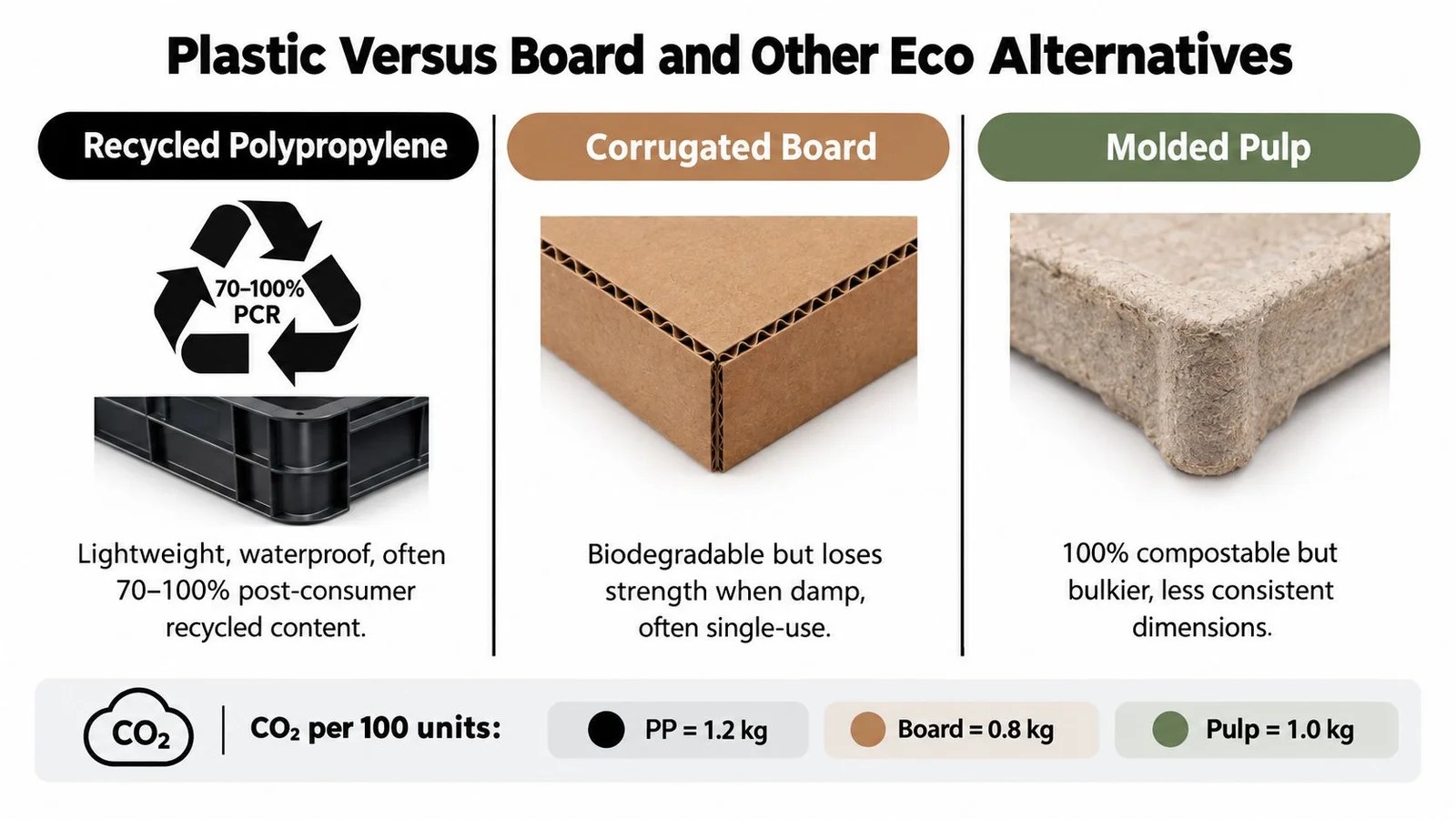
Plastic isn't automatically the wrong environmental choice. The better question is whether the protector is recycled-content, recyclable in a realistic route, or reusable across repeated movements.
Board-based corner protection has a clear advantage where the business needs a fibre-based, single-trip solution. Neutral packaging guidance commonly presents solid-board protection as reusable or recyclable, while plastic suppliers promote recycled polypropylene and recyclable formats. The decision depends on what happens after use, how much moisture the load encounters and whether the same protection can return to service.
Where plastic earns its place
A recycled PP protector can keep its shape when a load is handled repeatedly or stored in damp conditions. Plastic also doesn't absorb humidity in the way board can, so it remains more consistent when the pallet moves through variable storage environments. That makes it a practical option for returnable transport systems and loads that need dependable protection across multiple trips.
Board remains attractive for one-way distribution where the customer already has a reliable fibre recycling route. It can be the better choice when sustainability messaging is central to the product experience and the protector won't face demanding strap pressure, moisture or repeated handling.
Biodegradable alternatives need the same scrutiny. A material may be technically compostable yet unsuitable for the waste route available to the customer. Ask where it must be processed, whether local facilities accept it, and whether contamination from film, tape or product residue will prevent recovery.
Procurement test: judge the material by its complete journey, from manufacture and use through collection, sorting and recovery.
A buyer comparing options should document the local acceptance route rather than relying on a label. Review broader options in eco-friendly packaging materials and then test the selected protector on a real pallet.
The honest recommendation is to use recycled or reusable plastic when moisture, repeated handling or load stability makes board unreliable. Choose board where single-trip fibre recovery is the priority and performance demands are modest.
Buying in Bulk, Cost-per-Unit and Supplier Checks
Treat corner protectors as a recurring procurement line, not an accessory you buy only after a damage complaint. The unit price is only one part of the decision. A cheaper protector that slips, crushes or varies between batches can create more handling work and more damaged packaging.
Calculate the unit cost by dividing the delivered purchase price by the usable quantity, then add the operational effects. Include rejected or unusable pieces, storage space, picking time and the cost of replacing damaged goods. Don't claim a saving until a controlled trial shows that the selected profile performs on your actual loads.
What to ask the supplier
- Stock position: Can the supplier hold UK stock for repeat orders?
- Dimensional tolerance: Are leg length, channel width and wall thickness consistent between batches?
- Material evidence: Can the supplier document recycled content and recyclability for the exact product?
- Packing format: Do pieces arrive loose, bundled, counted or prepared for line-side handling?
- Compliance paperwork: Can the supplier provide relevant documentation for your application, including food-contact requirements where applicable?
- Repeat lead time: How quickly can the same specification be replenished during busy periods?
A box of loose pieces may suit manual packing. Taped bundles can speed up replenishment at a packing bench, while counted stacks may reduce stock discrepancies in a larger operation. Select the format that matches how your team picks and applies the product.
| Pack Size | Indicative Cost-per-Unit | Best Fit For |
|---|---|---|
| Small carton | Confirm from the supplier quotation | Low-volume or trial use |
| Mid-volume carton | Compare delivered cost with usable pieces | Regular despatch operations |
| Large pallet quantity | Negotiate against storage and handling needs | High-throughput distribution |
| Mixed-size order | Calculate each size separately | Multi-SKU warehouses |
Don't invent a saving model from a catalogue price. Run a trial, record failures, and compare the result with the cost of the protection. Buyers reviewing wider wholesale procurement principles can also consult how to find wholesale suppliers, particularly when evaluating stock, documentation and repeat-order reliability.
Quick Decision Checklist for UK Buyers
Use this checklist while reviewing a quotation or testing a sample. The strongest specification is the one your packing team can apply consistently and your waste process can handle.
Material
- Choose PP for rigid pallet loads and strong strap pressure.
- Choose LDPE where the edge is irregular or the outer surface needs a more compliant contact.
- Choose recycled content where the supplier can document composition and the UK recovery route.
Size
- Cover the strap zone. The protector must extend beyond the area receiving tension.
- Match the largest edge. Mixed SKU loads should fit the broadest carton edge without excessive looseness.
- Allow for board variation. Expandable profiles can simplify operations where carton calipers change.
Application
- Open L-profile: practical for routine carton strapping.
- Closed U-profile: suitable when the edge needs deeper coverage and improved retention.
- Expandable profile: useful for variable widths and mixed pallet construction.
- Tall protection: appropriate where a pallet column or stacked load needs extended support.
Supplier
- Confirm UK stockholding and repeat lead times.
- Request batch tolerance information for dimensions and fit.
- Obtain recycled-content and compliance documents before making an environmental or application claim.
- Test the load, including the actual strap, film and handling sequence.

Choose plastic where moisture, repeated handling or stacked loads would compromise board. Choose board where single-trip disposal and fibre recovery are the priority. Plastic is also the wrong call for a direct-to-consumer food hamper built around sustainability messaging, or for airfreight where reducing packaging weight matters more than maximum corner strength.
Monopack ltd offers catering and food-to-go packaging for cafés, caterers, takeaways and facilities teams, with flexible pack formats that can support organised packing operations. Visit Monopack ltd to review its packaging range and choose supplies that fit your products, handling process and sustainability requirements.


